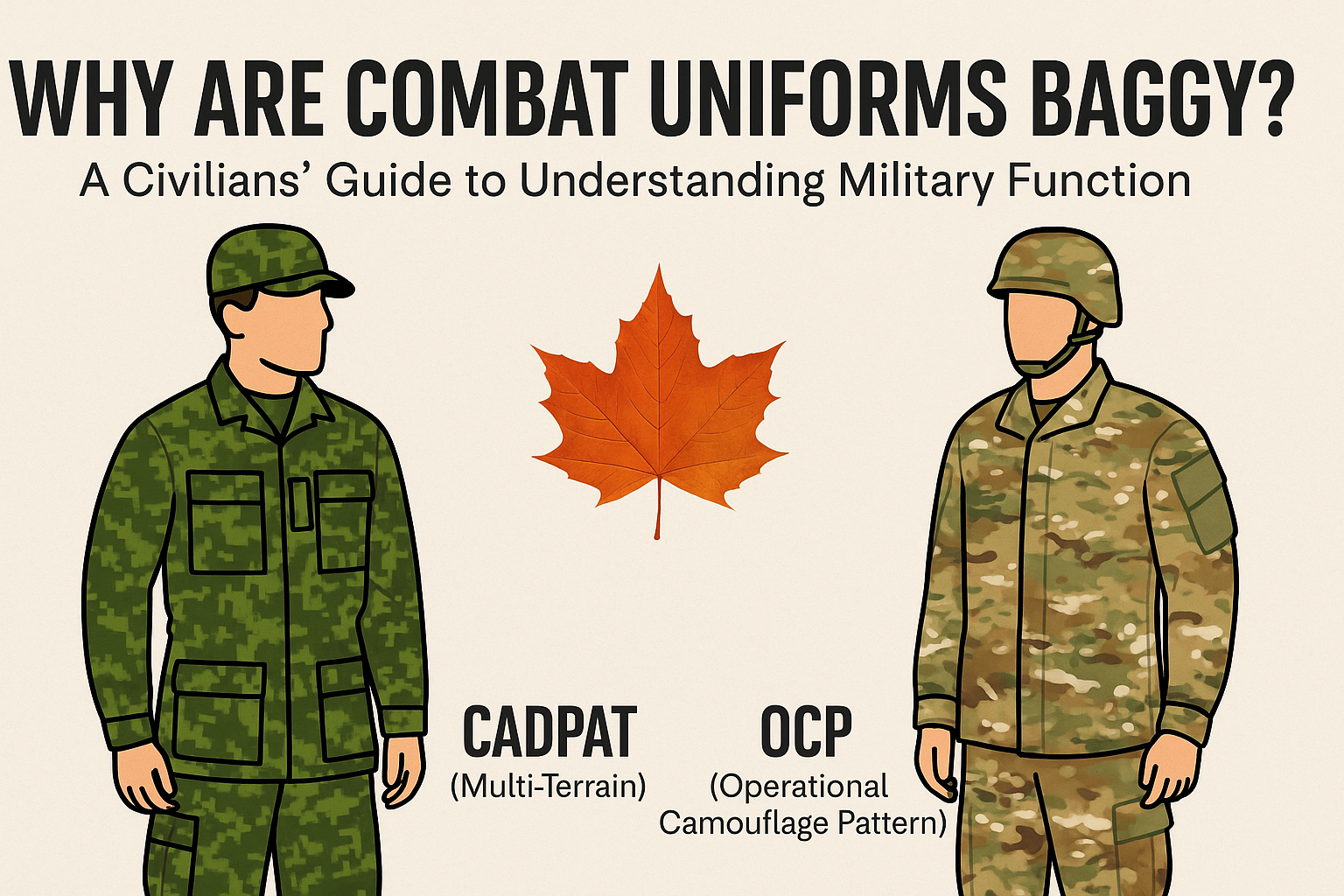
Ever wonder why military combat uniforms look loose or oversized? If you're not from a military background, it might seem like a strange design choice. But for those who serve, every part of that uniform is about mobility, survivability, and getting the mission done.
🔍 Function Over Fashion
Combat uniforms—like Canada’s CADPAT (Canadian Disruptive Pattern) or the U.S. military’s OCP (Operational Camouflage Pattern)—are baggy for a reason. These aren’t just clothing items—they’re tools designed for action.
A looser fit gives the wearer maximum freedom of movement. Whether it's crawling under obstacles, climbing over walls, or sprinting under fire, a tight uniform could restrict movement, reduce blood flow, or cause injury. Baggy designs help soldiers move quickly and comfortably in every terrain.
They're also made to handle the elements. Soldiers wear their gear in every climate imaginable—from Arctic cold to desert heat. The loose fit allows for layering thermal or weatherproof clothing underneath, or better ventilation in hot environments, helping to regulate body temperature and reduce fatigue.
🧰 Built for Battle: Ammo, Rations, and Critical Gear
Another big reason for the baggy design? Storage and function. Military uniforms are packed with large, accessible pockets—on the chest, sleeves, and thighs. These are for carrying ammunition, food rations, first aid supplies, maps, and communication tools—essentials that need to be reached quickly without digging through a pack.
The roominess also allows the uniform to fit comfortably over body armor, tactical belts, protective pads, and hydration systems. In combat zones or emergency response situations, this efficiency can be life-saving.
🪖 About the Camouflage Patterns
The camouflage pattern isn’t just for show either. The current Canadian military standard is CADPAT, and it’s evolving. A Multi-Terrain (MT) variant is now being adopted to replace older forest and arid versions—giving troops better concealment in diverse environments.
In the United States, the standard is the Operational Camouflage Pattern (OCP)—based on the widely respected MultiCam pattern. OCP is designed to blend into multiple terrains from woodland to desert, giving soldiers a tactical advantage wherever they deploy.
🫡 A Symbol of Readiness
To civilians, a baggy uniform might look casual. But to those who wear it—or have worn it—it’s a layered, battle-tested system. Every pocket, fold, and stitch has a purpose: mobility, protection, and survival. It's not fashion—it’s function.
So next time you see someone in uniform, know this: the extra room isn’t sloppiness. It’s strength, preparation, and purpose you’re looking at.
#CombatUniformsExplained#CADPAT #OCP #MilitaryGear10 #supportourheroes.directory#redfridaytalks.help